
In Loving Memory of Dr. Melanie Sage
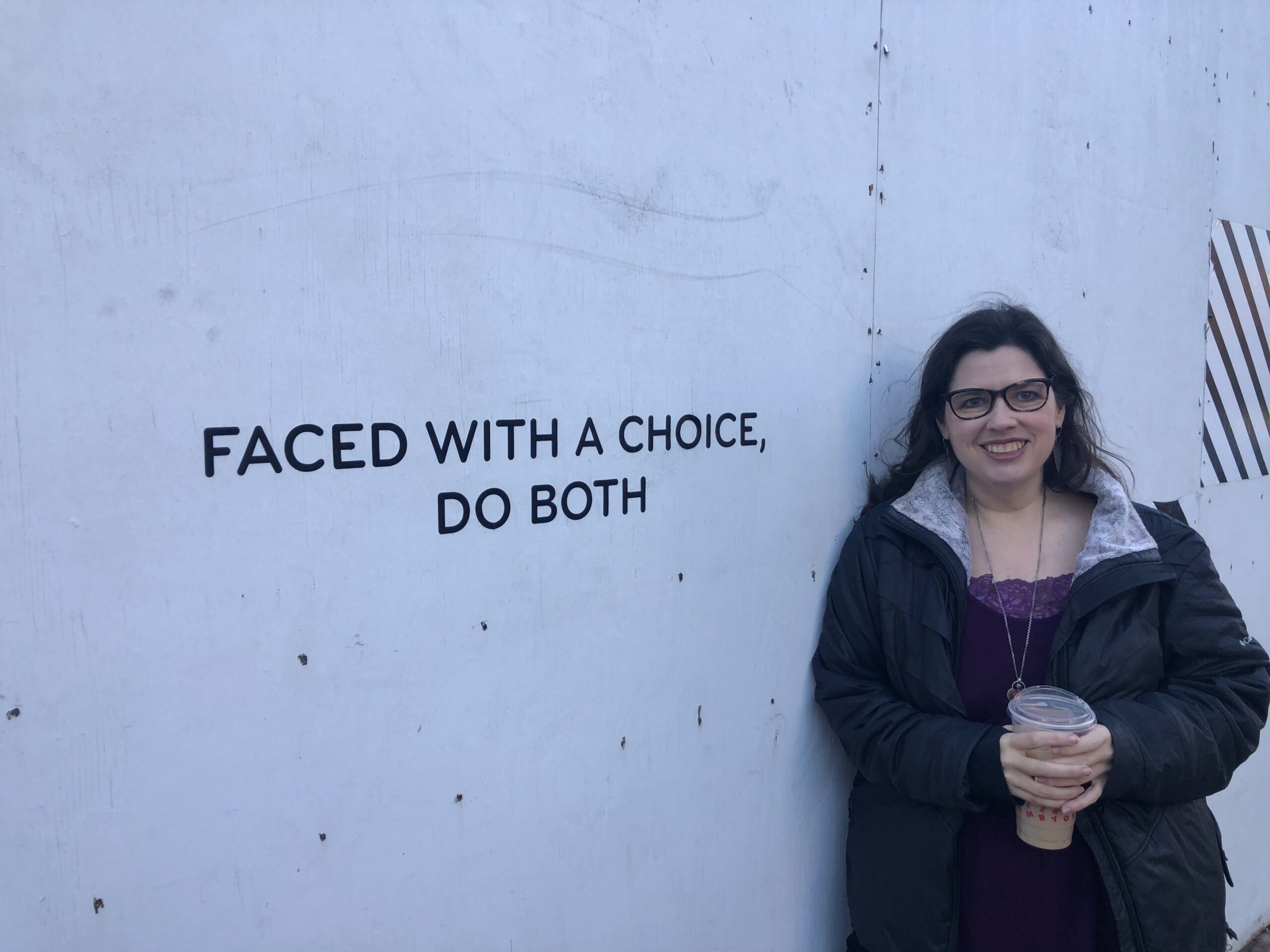
I don’t know if you’ve heard yet. Our friend and colleague, Dr. Melanie Sage, passed away on May 15th in Mexico following complications from surgery. Her husband, Todd and her family just finished an impossible week of getting Melanie home to the States. Four days in an ICU in Mexico came with costs that Todd and his family did not see coming. They had to work with an attorney to bring Melanie home to the States.
I wanted to reach out personally because Melanie mattered to me, and I imagine she mattered to you, too.
In partnership with Todd, we have set up a GoFundMe to help cover the costs of her care and bringing her home. Here is the link: GoFundMe for Dr. Melanie Sage
If you can give, please do. If you can share it, that matters just as much.
As for what comes next: Melanie was a simple, loving person and did not want a big funeral. She told Todd in the ICU that she wanted to be cremated and have her ashes spread in some of her favorite places, and that she wanted a celebration of life instead of a service.
She had one specific request for that celebration. She wanted everyone who loved her to write her a poem. Write about her, about you, and about the two of you together, whatever you want to say to her.
We have two options for sharing your poem:
- You can email the poem to wesocialworkllc@gmail.com. We will be posting them (with your permission) on the WeSocialWork website. Please also feel free to share a photo of you and Melanie to accompany your poem.
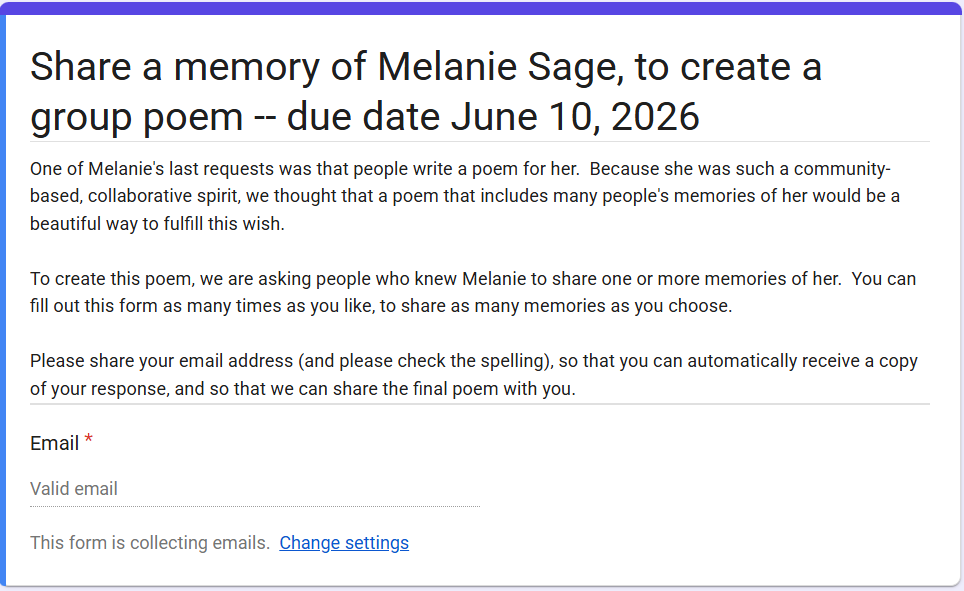
- You can contribute to creating a group poem for Melanie by completing this Google Form.
- And you can do both!
Todd knows many of her friends live far away and may not be able to attend the celebration of life in person. If that is your situation, please feel free to mail or email your poem to me, or simply keep it close to yourself as your own way of remembering her.
Please share this information with others as you can and want.
Making AI Use Visible: Why I Ask Students to Document Their Process

I use Generative AI tools, and started using them when they were first released. You can see how I started using AI to help with my work in this article that I published with colleagues in 2024 in the Journal of Social Work Education:
Báez, J. C., Bjugstad, A., Park, T. K., Jones, J. L., Bidwell, L. N., Sage, M., & Hitchcock, L. I. (2025). Social Work Educators Innovating With Generative AI: An Exploratory Study. Journal of Social Work Education, 61(1), 14–29. https://doi.org/10.1080/10437797.2024.2411170
As I reflect on this article now, I still see the role of AI tools in my work life as one of augmentation or support. The tools help me organize my thinking, draft an outline or get unstuck when I have a writing block. My confidence in using AI tools responsibly is rooted in professional identity, judgment, and ethical accountability. Students, by contrast, are encountering these tools at the same time they are learning what it means to think, write, and reason as social workers. Generative AI tools such as ChatGPT, Grammarly, Copilot, and others are now embedded in students’ daily writing environments. Some students are using these tools deliberately; others may not fully realize when browser extensions or autocomplete features involve AI. Meanwhile, our assignments in social work education are often writing-focused, inviting reflection, analysis, integration of theory and experience, and the development of critical thinking that grounds ethical practice.
Introducing My Substack: Writing Alongside Teaching and Learning in Social Work
For many years, Teaching and Learning in Social Work has been a central space for my writing about pedagogy, curriculum, and the practice of social work education. It has allowed me to think publicly about teaching, supervision, and professional learning, and to stay grounded in the values that shape my work.
I am excited to share that I am launching a Substack as a complementary space for my writing—one that will work alongside, rather than replace, this blog. You can find the Substack here: https://laureliversonhitchcock.substack.com/
Why Add a Substack?
Writing has always been how I make sense of my work and how I stay accountable to it. As a social work educator, clinical social worker, coach, and consultant, I spend much of my professional life thinking with others about learning, practice, supervision, ethics, identity, and change. Substack offers a different kind of writing environment: slower, more reflective, and more conversational.
This new space allows me to write in ways that do not always fit neatly into traditional blog posts or academic outlets, while still remaining grounded in scholarship, practice wisdom, and values-informed reflection.
How the Two Spaces Will Work Together
The Social Work Dimensions of Diversity Library Guide
One of my favorite parts of teaching social work is watching students discover the connections between theory and practice, especially those moments when social justice moves from abstract ideas to meaningful frameworks for understanding the world. Finding the right learning resources, such as a book, movie or podcast, to facilitate those discoveries hasn’t always been easy.
Like many of you, I’ve spent countless hours searching for materials that do more than just acknowledge diversity. I wanted resources that helped students understand how systems of power and privilege actually shape people’s lives, materials that centered the voices of those most affected by oppression. I also realized that if I, as a full-time educator, was spending a lot of time finding these resources, our adjunct faculty might be struggling too. Given that the Council on Social Work Education’s 2022 Educational Policies and Accreditation Standards (CSWE, 2022) now embeds requirements for diversity and equity content throughout social work curricula, I wanted to find a way to curate and share resources.
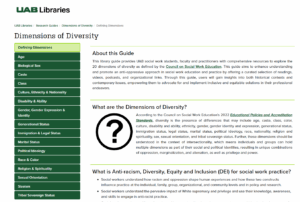
This idea led to an exciting collaboration with Dana Hettich, a reference librarian at the University of Alabama at Birmingham (UAB) Libraries. Together with help from Lana Turner, MSW Student and soon-to-be UAB alumnus, we developed the Social Work Dimensions of Diversity Library Guide, a project that has become more than just a teaching resource. It’s evolved into a living, collaborative space where students, faculty, and librarians work together to build something meaningful.

Teaching & Learning in Social Work by Laurel Iverson Hitchcock is licensed under a Creative Commons Attribution-NonCommercial-ShareAlike 4.0 International License